
Compared to traditional braces, clear plastic aligners can be an attractive and flexible option for some teens in straightening their permanent teeth. Unlike traditional braces, clear aligners are nearly invisible when worn, and for mild to moderate orthodontic treatment they can give results comparable to braces while providing the advantages inherent in being removable.
In this blog post, we cover how clear aligners can be a practical and flexible alternative to braces for some teenagers. We will discuss:
- How clear aligners for teens work
- The kinds of orthodontic issues that clear plastic aligners work best for
- When braces may still be a better choice
- Considerations for you as a parent when deciding if your teenager is ready for clear aligner treatment
Call Kids Dental to Learn More About Clear Aligner Treatment Options
Your first consultation with our orthodontists at Kids Dental is free, so you and your teen can see for yourselves how clear aligner treatment may help your teen to have all the health-improving and confidence-building benefits that come with straight teeth and a healthy, inviting smile.
Call us today at (602) 903-4894 or reach out to us online to set up your free initial consultation.
How Do Clear Aligners for Teens Work?
Clear plastic aligners are custom-made orthodontic treatment appliances. They are trays that are specifically designed for your teen’s upper and lower teeth. Clear aligner treatment involves multiple sets of trays over time. Each set of trays applies gentle pressure on teeth to gradually correct misalignments in the same way that traditional braces do, only without the metal brackets, archwires, and elastic bands.
Getting started with clear aligner treatment is a multi-step process. It begins with an evaluation by your child’s orthodontist to determine whether his or her treatment needs are compatible with aligner treatment. The evaluation uses photographs, dental impressions, x-rays, and digital imaging to examine your child’s teeth, bite characteristics, jaw relationships, dental development, and overall oral health.
Once the evaluation is finished, if aligner treatment is practical, then one of our orthodontists will create a treatment plan. This process identifies which misaligned teeth need repositioning, how far they need to move, and the correct sequence.
Before aligner treatment begins, any necessary dental work should be completed, and the teeth and gums should be healthy enough for orthodontic movement.
Based on your child’s treatment plan, the next step is to create the custom-made aligner trays. Your child will wear each tray set for anywhere from one to three weeks before going to the next set. In some cases additional appliances may also be needed, like small, tooth-colored attachments that bond to select teeth or orthodontic elastics to apply additional realignment pressure where needed.
During the treatment period, about every six to ten weeks your child will make regular visits to the orthodontist to monitor realignment progress, evaluate the health of his or her teeth and gums, and make adjustments to the treatment plan if necessary. This visit interval may vary depending on your child’s specific orthodontic treatment needs.
When your teenager completes the treatment process with the last set of aligner trays, the orthodontist will usually prescribe a retainer to help ensure that the teeth will remain in their new positions.
We Use Invisalign Teen Clear Aligners
Perhaps the most well-known clear aligners for teens are made by Invisalign®. Our orthodontists at Kids Dental are authorized Invisalign dentists who are trained in how to use Invisalign diagnostic equipment and software to create a customized tooth alignment and smile recovery plan just for your child. We offer Invisalign clear aligners for teens as “Invisalign Teen.”
Invisalign Teen offers the same technology as regular Invisalign aligners, but their design makes Invisalign Teen aligners ideal for younger patients. Specifically, Invisalign Teen aligners are shaped to accommodate smaller mouths and jaw sizes, including eruption tabs for teeth that are still erupting and small blue dots called compliance indicators that fade with wear so you can get a visual idea of how many hours a day your teen is wearing them.
Invisalign treatment usually takes 12 to 18 months to complete. Invisalign Teen costs about the same as traditional braces. Invisalign Teen aligner treatment begins with an initial free consultation appointment at one of our offices in North Phoenix, Central Phoenix, Scottsdale, Avondale, Peoria, or Surprise, so you can see how Invisalign works.
Which aligner brands are available can vary by location. In some cases, depending on factors like cost, availability, and the need for clinical supervision, you may consider clear aligners made by other brands like ClearCorrect®, Spark™ Clear Aligners, or CandidPro™.
What Are the Advantages of Clear Aligners for Teen Orthodontic Treatment?
The removability of aligners like Invisalign supports an active lifestyle for most teens. Your teen can remove the aligners for contact sports, swimming, or playing a wind instrument, eat whatever he or she wants, feel more comfortable smiling and speaking in social situations, and be free from orthodontic emergencies like broken brackets or wires.
What Orthodontic Problems Can Clear Aligners Commonly Address?
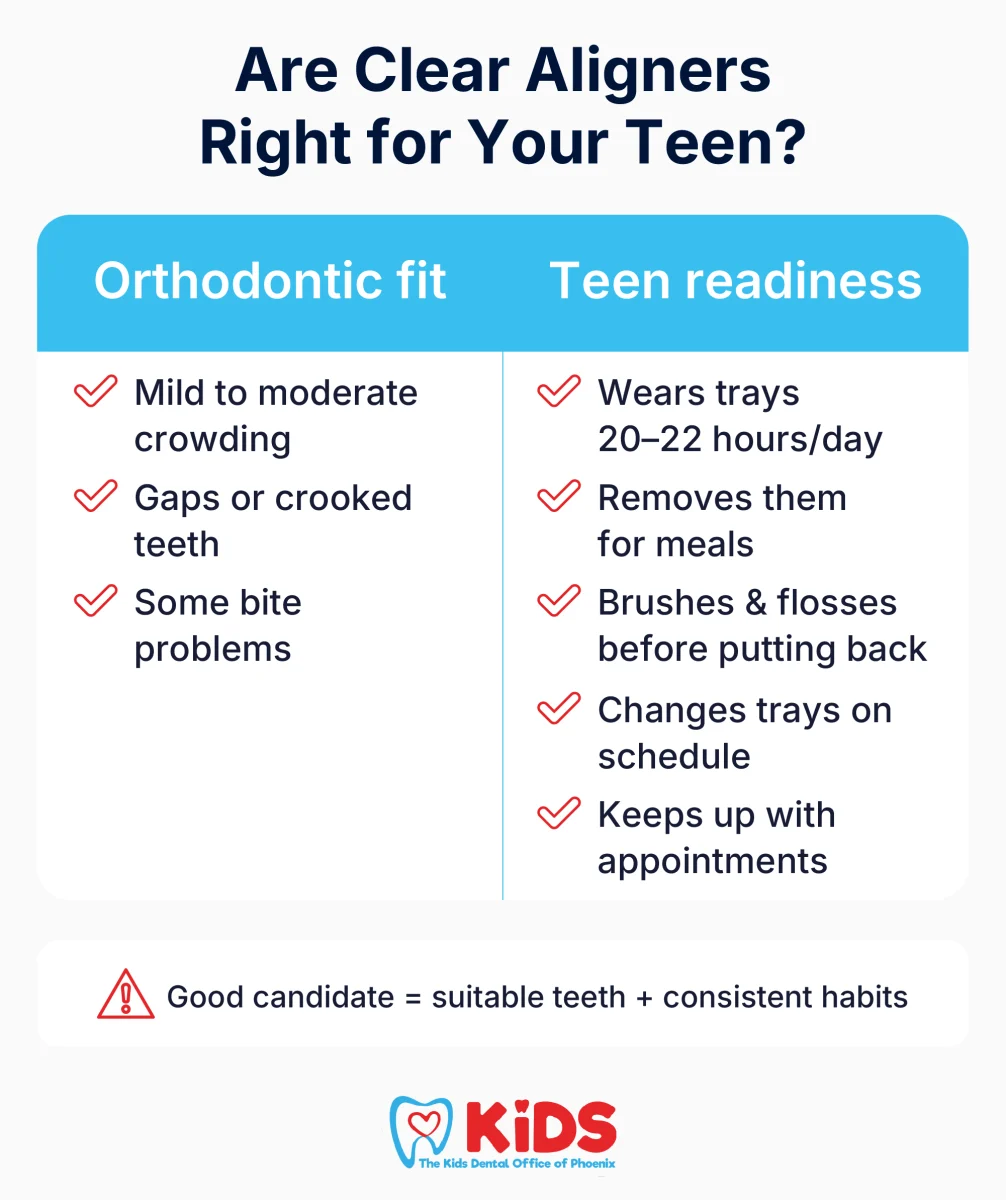
As we mentioned above, clear plastic aligners can achieve results comparable to braces in most mild-to-moderate orthodontic teen treatment needs. Examples of orthodontic problems that aligners can often help with for many teens include:
- Mild to moderate teeth crowding
- Gaps or spacing between teeth
- Crooked or mildly rotated teeth
- Bite issues like mild-to-moderate overbites, underbites, crossbites, and open bites
- Minor tooth movement that may happen after previous orthodontic treatment
Not all of these kinds of orthodontic cases are always treatable with clear aligners. Each case is unique, and your orthodontist must evaluate your teen’s needs in light of the severity of the problem, the positions of the teeth and roots, jaw growth, and other factors.
When Might Braces Be More Appropriate than Clear Aligners?
The more severe the underlying orthodontic issue, the greater the chance becomes that traditional braces may be the best treatment choice. Teen orthodontic treatment cases well-suited for braces include:
- More complex or severe bite problems
- Impacted or unerupted teeth
- A major problem with jaw size or a discrepancy in jaw positioning
- The need for tooth extractions and significant space closure
- The need to correct major tooth rotations
- Difficult root torque or root movement problems
- Substantial tooth vertical movements or extrusions
- A need for skeletal expansion
- Untreated cavities, gum inflammation, or other significant oral health problems
- Difficulty with consistently wearing removable aligners
The table below summarizes the functional and cosmetic differences between braces and clear aligners for teens.
| Consideration | Clear aligners | Traditional |
|---|---|---|
| Appearance | The thin, transparent trays are less noticeable, although attachments may still be visible. | Metal braces are visible, although other bracket materials may be less noticeable. |
| Comfort | Smooth plastic usually causes less cheek and lip irritation.Some pressure and temporary soreness can occur with a new tray. | Brackets and wires may irritate soft tissues, especially after initial placement or adjustments. |
| Removability | Trays can be removed for meals and cleaning.Frequent or prolonged removal can make treatment less effective. | Braces remain fixed to the teeth. This method eliminates the risk of forgetting to wear aligners. |
| Eating | No bracket-related food restrictions.The trays must be removed before eating and before drinking anything other than water. | Hard, sticky, crunchy, or chewy foods may damage brackets or wires. |
| Cleaning | Teeth can be brushed and flossed normally.The trays and teeth must be cleaned with a soft toothbrush before reinsertion. | Brackets and wires create additional areas where plaque and food can collect, requiring more intensive brushing. |
| Treatment discipline | Treatment success depends heavily on daily wear, correct tray changes, storage, and attendance. | Lower wear-time burden because the appliance is fixed. |
| Complex cases | Effective for moving teeth into desired positions in mild-to-moderate orthodontic treatment. | Often provides greater control for severe malocclusions, extraction mechanics, root positioning, and complex movements. |
| Cost | Cost depends on treatment complexity, treatment length, included refinements, retainers, insurance, and provider. | Cost depends on the type, complexity, duration, and insurance.In some practices, metal braces may be the more affordable option. |
Is Your Teen Ready for Clear Aligners?
The suitability of your child’s orthodontic treatment needs is half of the consideration for whether he or she is a good candidate for clear aligners. The other half is your child’s temperamental suitability to make the best use of the aligner treatment plan.
To produce the best results for your teen’s smile, clear aligners like Invisalign for teens require consistent wear, proper cleaning, and maintaining scheduled visits with our orthodontic team.
The failure of a teenager to carefully observe and follow the clear aligner plan can lead to treatment delays, possibly including the need to revise the series of aligner trays if progress falls behind. Consider in advance whether your teenager can consistently handle the following responsibilities.
Wearing the Trays as Directed
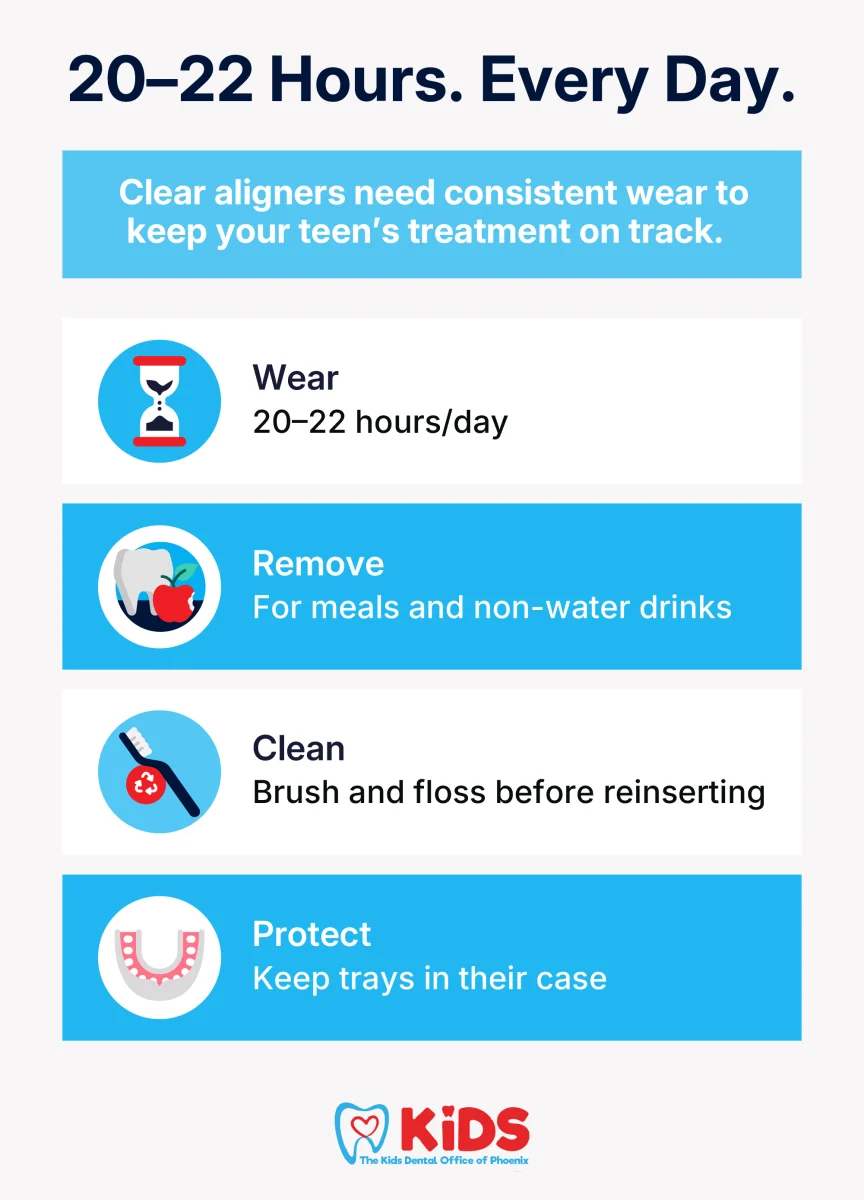
To work properly, clear aligners must remain in your child’s mouth for 20 to 22 hours a day. Aligners generally come out only for eating, drinking anything other than water, and brushing and flossing. A teen who frequently forgets to put the trays back in or who regularly leaves them out for school, social activities, or sports may be better served by traditional braces.
Maintaining Good Oral Hygiene
The ability to remove clear aligners makes brushing and flossing easier than cleaning around brackets and wires, but it does not eliminate all risks of tooth decay and gum disease. This is especially true if your child does not keep his or her teeth clean before replacing the aligners in the mouth.
Food particles and sugary or acidic liquids can become trapped beneath aligners, so teens should brush and, if possible, floss their teeth before reinserting the trays.
Keeping Track of the Aligners
Each tray must be worn in sequence and stored in its protective case when it is out of the mouth. Wrapping an aligner in a napkin, leaving it loose in a backpack, or placing it where a pet can reach it increases the chance of loss, damage, or contamination.
Changing Trays and Attending Appointments
Your teen must change the aligner trays on the prescribed date and attend progress checks. Wearing a set of trays for too long can delay treatment progress by allowing teeth to stabilize in their current position rather than advancing to the next stage, and the aligner plastic may begin to degrade or break down, losing its effectiveness. Additionally, keeping a worn-out tray in place too long can potentially require revisions to the treatment plan or new sets of trays.
Participating in the Decision
A teenager who understands how clear aligner treatment works and wants to participate is more likely to follow the routine consistently. Here are some questions that can help you and your child make an informed decision on whether clear aligners are the best choice:
- Will I wear the trays for the required number of hours every day?
- Will I take them out before meals and non-water drinks?
- Will I brush and floss before putting them back in?
- Will I store them in their case instead of a napkin, pocket, or backpack?
- Can I change trays on schedule without getting ahead or falling behind?
- Will I tell a parent or the orthodontic office if a tray is lost, damaged, or no longer fits?
- Will I attend follow-up appointments and regular dental checkups?
- Am I willing to wear a retainer after treatment?
Traditional braces work in most orthodontic treatment situations and may be the best choice for your teenager if your teen is unlikely to wear aligners consistently through the end of treatment. Clear aligners not consistently worn, or cleaned, or maintained can result in a delayed and incomplete treatment process that may end up in the need for braces in any event.
The best candidates for clear aligner treatment generally have the maturity to wear, clean, and protect their trays every day.
The Best Next Step: An Orthodontic Evaluation at Kids Dental
Based on the numerous advantages they offer, clear aligners like Invisalign treatment can be an excellent alternative to traditional metal braces for straightening teeth in many teenagers, but ideal clear aligner treatment candidacy depends on more than age or appearance.
Our orthodontic team at Kids Dental considers tooth and root positions, bite severity, jaw growth, oral health, eruption patterns, required movements, and your teen’s ability to follow the treatment routine.
Call us at (602) 903-4894 or use our online contact form to schedule an orthodontic evaluation to learn whether clear aligners, traditional braces, or another treatment plan offers the safest and most predictable path for your teen’s beautiful smile. Bring your questions about wear time, school routines, sports, oral hygiene, treatment length, insurance, and total cost so your family can make a confident, informed decision.