
About 40% of your child’s tooth surface area may be effectively inaccessible to a toothbrush. Pediatric dentists refer to these “blind spots” as proximal surfaces, and without proper preventive oral hygiene, they are prime candidates for tooth decay in the form of interproximal cavities. These cavities can affect closely spaced baby teeth and permanent teeth in older children and teenagers.
In this blog post, we cover interproximal cavities: how they form, what you can do at home to reduce the risk factors, and how your pediatric dentist can detect and treat them.
Call Kids Dental for Your Child’s Interproximal Dental Health Care
From baby teeth to braces, Kids Dental proudly serves Phoenix families with six convenient locations: Scottsdale, Peoria, Central Phoenix, North Phoenix, Avondale, and Surprise. Our doors are open for every pediatric oral health need, including checkups and cleanings that can detect interproximal cavities in their early stages and treat them before they lead to bigger problems like deeper decay and infection.
In addition to the required training to be licensed dentists in Arizona, our pediatric dentists complete two years of additional post-dental school training in pediatric dentistry. We offer online scheduling and flexible hours for parents, and in many cases we can provide same-day dentistry for dental emergency walk-in appointments.
To schedule a dental appointment with us, call (602) 903-4894 or contact us online.
Why Can Cavities Form Between Teeth Despite Proper Brushing?
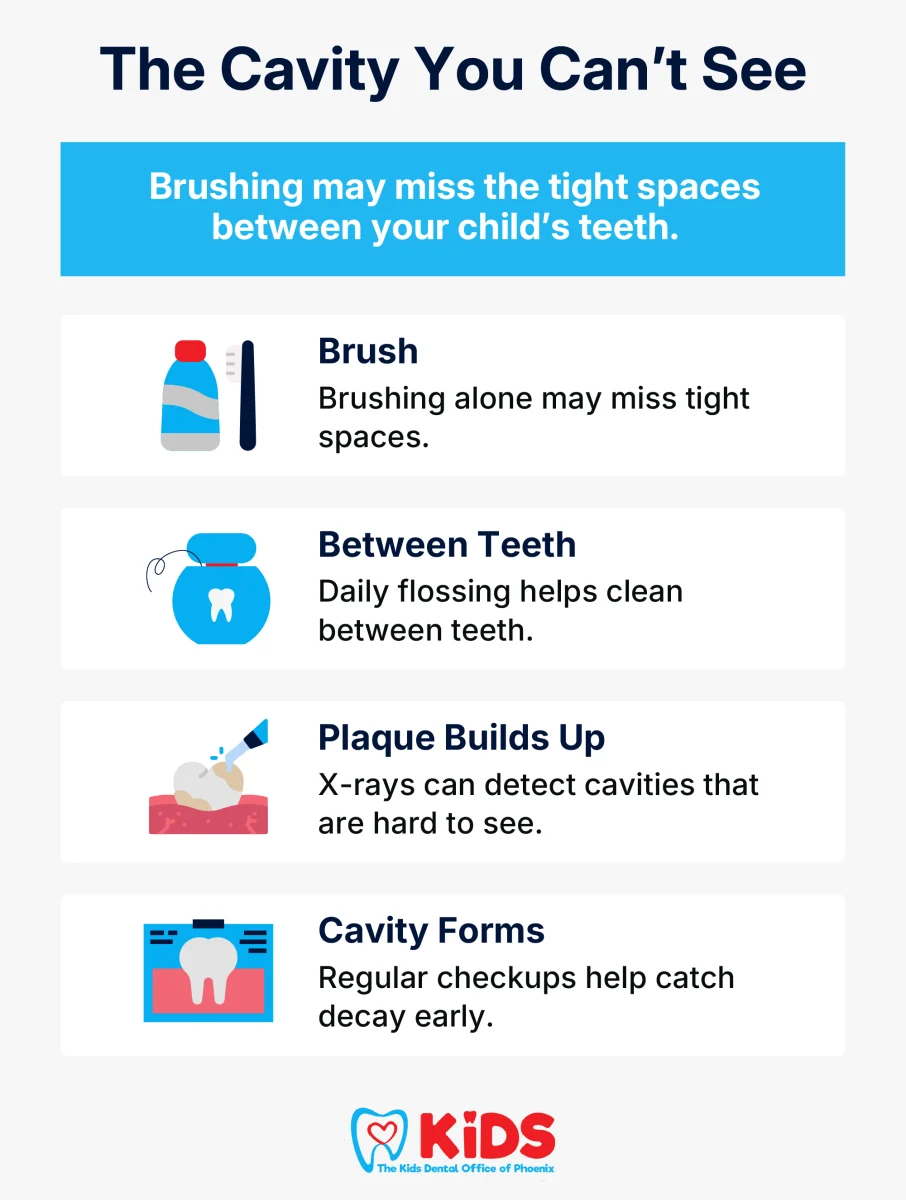
If your child’s oral care routine consists solely of consistent brushing without flossing, then small food particles can get stuck in the spaces between teeth. It does not matter how thoroughly he or she brushes or how often: the bristles on a toothbrush cannot reach into these tight spaces.
Decaying food particles break down into sugars and starches that cavity-causing bacteria feed on. This is how dental plaque buildup forms. The bacteria produce acids as a waste product of this feeding process, and these acids are corrosive to tooth enamel.
Left undisturbed for long enough, bacterial acids will break down tooth enamel to the point where cavities between teeth can form.
In permanent teeth, the spaces between molars pose significant problems for interproximal cavities, because visual inspection often will not reveal plaque buildup and tooth decay.
Why Parents Often Cannot See These Cavities
An interproximal cavity develops on the side of a tooth that faces a neighboring tooth, so even if you are looking for signs of cavities, chances are good you will not see them. This is especially true with the molars in the back of the mouth.
Nor is it a good strategy to rely on your child to tell you about mouth pain and discomfort to give you early warning of interproximal cavities. The early stages of tooth decay usually cause no pain or other obvious symptoms, so by the time your child starts feeling tooth pain or sensitivity to hot or cold foods and beverages, the tooth decay may have compromised the enamel to the point where a cavity has already formed.
This is one reason regular dental checkups and preventive dental examinations remain important even when your child’s teeth look normal and your child is not complaining about any problems.
Possible Warning Signs of a Cavity Between Teeth
Cavities between teeth often cause no symptoms at first, but as they grow, they can cause the same signs as any other cavity. If you observe any of the following, then call Kids Dental to schedule an appointment:
- Your child is experiencing a toothache, difficulty chewing, or persistent bad breath
- Your child becomes sensitive to sugary and acidic foods or to hot or cold foods and drinks
- You see a white, brown, or dark discoloration near an accessible edge of a tooth
- You see a visible opening in the surface of a tooth as a cavity becomes larger
- Your child experiences mouth pain, facial swelling, or fever; these can be signs of an infection.
How You Can Help Prevent Cavities Between Teeth
As a parent, you can take proactive steps to help your child minimize the chance of tooth decay getting a foothold between teeth.
Brush Regularly and Use a Fluoride Mouthwash
Brushing twice a day for at least two minutes each time with a soft-bristle brush and fluoride toothpaste can help to prevent cavities on exposed tooth surfaces and reduce the amount of food particles that might otherwise work their way in between teeth. For children 6 and older, using a fluoride mouthwash can also help to reduce bacteria in the mouth.
Floss Between Touching Teeth Daily
Daily flossing reaches the side surfaces of teeth that toothbrush bristles cannot fully clean, helping to remove plaque and food debris and reducing the food supply for mouth bacteria.
Your child should start flossing when and where any two teeth touch. Young children normally need an adult to floss for them until they have the coordination to clean each contact effectively. Children often become ready to take over flossing at around age 10 or 11.
Depending on your child’s circumstances, age, and whether he or she is being treated with orthodontics, some flossing options may be more suitable than others. Ask the Kids Dental AZ team about handled flossers, small interdental brushes, and water flossers if traditional string floss is difficult for your child to use.
Reduce Frequent Sugary Foods and Starch Exposure
The less fuel supply harmful bacteria have, the less acid they can produce. Encourage a balanced diet, water between meals, and planned healthy snacks rather than allow your child to engage in frequent snacking on foods and beverages high in sugar.
Review Your Child’s Fluoride Exposure
Fluoride toothpaste, fluoridated drinking water, and professionally applied fluoride can help prevent mineral loss in enamel and support early remineralization. Let your pediatric dentist know whether your child primarily drinks tap, bottled, filtered, or well water. Your child’s fluoride plan should be based on drinking-water fluoride levels, other fluoride sources, age, and individual cavity risk. Fluoride supplements should only be used when your dentist recommends them.
Maintain a Schedule of Regular Dental Check-Ups
Professional preventive care includes oral examinations, cavity-risk assessments, hygiene coaching, dietary counseling, professional cleaning when needed, fluoride recommendations, and selective X-rays when clinically necessary.
At Kids Dental, we recommend regular dental visits every six months, although children at higher or lower risk may need a different schedule.
During an examination, the dentist will inspect your child’s teeth and gums. If we cannot directly examine the contacts between back teeth, we may recommend bitewing x-rays to help identify decay between teeth and evaluate how far a lesion extends into tooth enamel or dentin. Your pediatric dentist can also review which preventive services are appropriate as your child moves from primary teeth through mixed dentition and eventually to the permanent teeth.
How Are Cavities Between Teeth Treated?
The treatment methods for an interproximal cavity depend on how far the tooth decay has progressed.
Early, Non-Cavitated Decay
Finding decay earlier provides more opportunities for conservative care. If tooth enamel mineral loss is still limited to an early enamel lesion and no hole has formed, then your dentist may recommend continued home care, daily flossing, dietary changes, professional fluoride, and close monitoring. Fluoride can help replace lost minerals and may stop or reverse early decay before the enamel surface breaks down.
For some non-cavitated interproximal lesions, resin infiltration may be possible. This minimally invasive treatment places a low-viscosity resin into the enamel to slow or stop the progression of decay.
When a Cavity Has Formed
Once the enamel surface has broken down and the decay progresses to the point where the first sign of a cavity is present, the tooth may need a filling.
Dental fillings are the most common treatment for cavities in children. After numbing the area, our pediatric dentist will remove the decayed portion of the tooth and fill the space with a composite resin material.
The filling material choice depends on the cavity’s size and location. The choice of filling material also varies based on whether the cavity is in a primary tooth or a permanent one.
Deep Decay
If further decay approaches deeper layers of the affected tooth like its pulp, then treatment may involve a protective dental procedure such as a pulpotomy, and, if needed, an appropriate restoration or crown. The dentist’s recommendation will depend on whether the tooth is a baby or permanent tooth, the condition of the pulp, your child’s symptoms, dental x-ray findings, whether the tooth can be restored, and how long the tooth is expected to remain in the mouth.
Dental crowns are used when a cavity is so extensive that it has severely weakened the tooth structure. The dentist will remove the severely decayed portion of the tooth and place a fabricated crown over the entire tooth to restore its shape, chewing surface, strength, and function.
Root canal treatment may be needed if the cavity has reached the inner pulp of the tooth, causing infection or severe pain. This procedure removes the infected pulp, cleans out the root canal, and seals it with a filling material. In some cases, the dentist may also put a dental crown in place to protect and strengthen the tooth.
Tooth extractions may be necessary if a cavity has severely damaged the tooth and it cannot practically be restored. If the extracted tooth was a permanent one, then after the extraction, the dentist may recommend a tooth replacement, like a dental implant, bridge, or dentures, or a space maintainer.
If treatment of an interproximal cavity is delayed too long, then, in addition to deep decay, other potential problems can arise. These include infection of the surrounding gum tissue, the tooth falling out on its own, and even a general infection that spreads beyond the mouth and into the bloodstream.
See the Pediatric Dentists at Kids Dental for Your Child’s Optimal Oral Health
A hidden cavity between your child’s teeth does not mean that you or your child have done anything wrong. Interproximal cavities are difficult to see and can develop in areas that regular brushing alone cannot fully reach. Introducing your child to good oral hygiene habits like a daily dental flossing routine, routine cleanings, and early detection gives you the best opportunity to prevent tooth decay and use preventive or minimally invasive care before tooth decay becomes painful or requires more extensive treatment.
If your child has noticeable symptoms like tooth sensitivity, difficulty chewing, or mouth discomfort, has teeth with close contacts or a history of cavities, or has not had a recent preventive visit, then contact Kids Dental AZ to schedule a pediatric dental exam.
One of our experienced pediatric dentists can examine the visible tooth surfaces, assess your child’s individual risk for interproximal cavities and identify cavities if they are present, and determine whether treatment is needed and what kind of treatment it should be.