
Children normally have 20 primary teeth (“baby” teeth) and later 32 permanent (“adult”) teeth. Sometimes, however, a child can have more than the usual complement of teeth. When this happens, dentists call these extra teeth “supernumerary” teeth. A supernumerary teeth condition is also known as hyperdontia.
Pediatric dentists, like the ones at Kids Dental, have the training and expertise to treat supernumerary teeth. In this blog post, we cover the following topics about supernumerary teeth:
- What they are
- What causes them
- Problems that supernumerary teeth can cause for your child
- How your pediatric dentist diagnoses and treats supernumerary teeth
- When to schedule an appointment for your child for a supernumerary teeth condition
How Kids Dental Can Help if Your Child Has Supernumerary Teeth
The pediatric dentists at Kids Dental have the professional training and experience to diagnose supernumerary teeth and to take appropriate treatment measures. Not every extra tooth may need to be extracted; we can advise you on what you can do as a parent and the best options for your child’s unique situation.
To learn more about our pediatric dentistry and orthodontics services and to schedule an appointment with us, call our office at (602) 903-4894 or use our online contact form.
What Are Supernumerary Teeth?
A supernumerary tooth is any tooth in excess of the normal number of baby teeth or permanent teeth. Commonly, a child will have one supernumerary tooth, but some children will have more than one.
Supernumerary teeth can manifest at any time and appear anywhere in your child’s mouth. They occur most often as “mesiodens” between the upper front teeth (the central incisors). They affect 1% to 3% of people, with the rate in boys being about twice that in girls.
Types of Supernumerary Teeth
The table below shows the types of supernumerary teeth that your child might develop, where they appear, and what they may look like.
| Type | Characteristics |
|---|---|
| Mesiodens | A mesiodens is an extra tooth between the two upper permanent incisors.Mesiodens is the most common supernumerary tooth in children; different studies estimate that about one-third of supernumerary teeth are mesiodens.Mesiodens may be pointed, small, or unerupted. |
| Supplemental tooth | A supplemental tooth is an extra tooth that closely resembles a normal tooth, like an additional lateral incisor or premolar.A supplemental tooth can be difficult to tell from a normal tooth without X-rays. |
| Supernumerary premolar | A supernumerary premolar is an additional tooth near the premolars.Supernumerary premolars are often found in the lower jaw and may develop later than front-tooth supernumeraries. |
| Paramolar | A paramolar is a small extra tooth beside a molar.It is usually found on the cheek or tongue side of the dental arch. |
| Distomolar | A distomolar is an extra tooth behind the last molar.Distomolars are less common in young children and are often found incidentally on a panoramic X-ray. |
Supernumerary teeth can also be described by their shape:
- Conical teeth are small and peg-like
- Tuberculate teeth are usually barrel-shaped with more than one cusp
- Molariform teeth resemble miniature premolars or molars.
The shape of a supernumerary tooth matters because it can influence whether the tooth is likely to erupt or to interfere with a nearby permanent tooth.
What Causes Supernumerary Teeth?
Pediatric dentists have not established the precise cause of supernumerary teeth. Some studies have suggested they are the result of excessive activity in the dental lamina, the layer of dental tissue that creates tooth buds during a child’s fetal development.
Certain pre-birth factors can be associated with a greater chance of them appearing. These include:
- Genetic disorders and some inherited syndromes, like cleidocranial dysplasia, Gardner syndrome, or trichorhinophalangeal syndrome
- The presence of a cleft lip or a cleft palate
In many children, though, a single supernumerary tooth can be present without any of these conditions. Researchers think genetic and environmental factors may both play a role.
Cleidocranial Dysplasia
Cleidocranial dysplasia, or CCD, affects the development of teeth and bones. It is one of the strongest genetic associations with multiple supernumerary teeth. Dental care for CCD frequently involves long-term coordination among pediatric dentistry, orthodontics, and oral surgery. Treatment may include removing extra teeth, exposing impacted permanent teeth, and orthodontics.
Gardner Syndrome
Gardner syndrome is a form of familial adenomatous polyposis (FAP), which is caused by changes in the APC gene. It is a hereditary cancer-predisposition condition. Your pediatric dentist’s role in Gardner syndrome cases is to recognize its symptoms and to coordinate referrals to appropriate specialists.
Cleft Lip and Palate
Children with cleft lip, cleft palate, or both of these cleft formation conditions have higher rates of supernumerary teeth. Extra teeth commonly occur close to the cleft region, especially around the upper lateral incisor area.
Pediatric dental care for cleft lip and cleft palate is best coordinated with your child’s cleft or craniofacial team, because tooth removal, orthodontics, and procedures like alveolar bone grafting must be carefully sequenced.
Problems Extra Teeth Can Cause
Many times, supernumerary teeth cause no symptoms. But some can lead to problems that can affect your child’s dental development if left untreated. Some of the common supernumerary tooth development problems your child might encounter include:
- Delayed eruption or blocked eruption. An impacted supernumerary tooth can prevent a permanent tooth from being able to come out. For example, even when it remains hidden, a mesiodens can block the normal eruption path of a permanent front tooth.
- Displacement or rotation. A supernumerary tooth can cause a developing permanent tooth to be pushed sideways or forced to erupt abnormally.
- Crowding or unwanted spacing. An erupted extra tooth can consume arch space in your child’s mouth, while an unerupted mesiodens can contribute to a midline gap.
- Impaction. A supernumerary tooth or the normal permanent tooth may remain trapped in the bone underneath the gums.
- Bite concerns. Altered tooth position or crooked teeth can affect how your child’s upper and lower teeth fit together.
- Effects on neighboring roots. In some cases, a supernumerary tooth can lead to root resorption, abnormal root development, or loss of vitality in an adjacent tooth.
- Cyst formation. A fluid-filled sac called a dentigerous cyst can develop around the crown of an unerupted supernumerary tooth.
- Oral hygiene challenges. An awkwardly positioned erupted tooth may create areas that are hard to effectively brush and floss.
How Pediatric Dentists Diagnose and Treat Hyperdontia
Regular dental visits are the best way for your child to avoid complications from extra teeth. The first step in diagnosing hyperdontia is usually when you take your child to a regular dental checkup.
This visit usually begins with the dentist’s review of your child’s medical, dental, and family history, followed by an examination. The dentist examines the number and shape of visible teeth, compares eruption on the right and left sides, checks retained baby teeth, evaluates available space, and looks at your child’s bite. The dentist may also gently feel the gums or palate for any unerupted teeth.
The routine exam can, by itself, reveal the presence of an extra tooth. But in some cases, especially when the supernumerary tooth has not erupted, pediatric dentists discover supernumerary teeth on x-rays of your child’s mouth.
In more complex cases, the dentist may order a cone-beam computed tomography scan to create a detailed three-dimensional image of your child’s mouth showing the exact position, size, and angle of the supernumerary tooth.
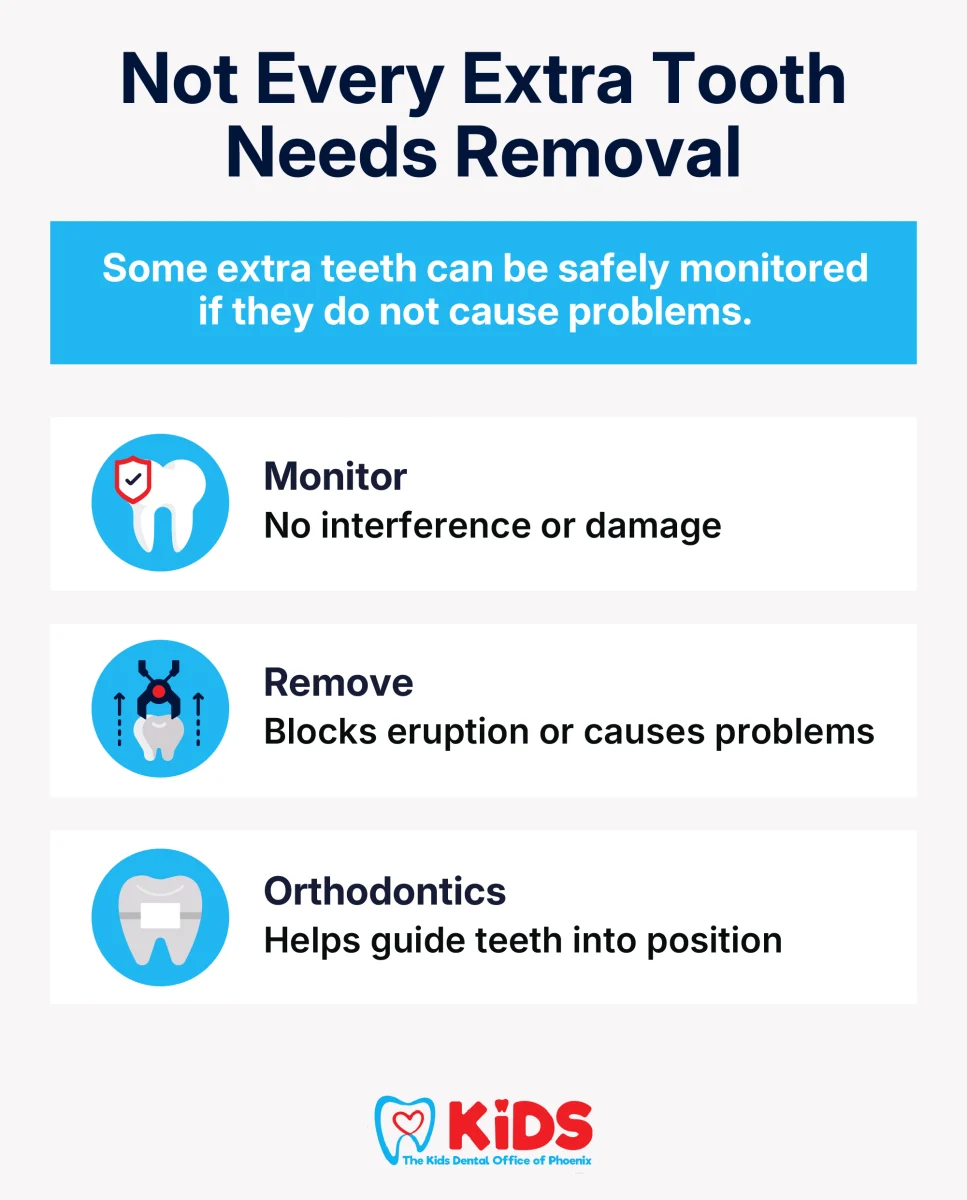
If one of our dentists finds an extra tooth, then the treatment plan depends on the situation:
- Monitor: If the extra tooth is not causing problems, then we may simply watch it over time.
- Remove: If the extra tooth is blocking the eruption of a normal tooth, or it is crowding other teeth, or it poses the risk of a cyst formation, then surgical removal is often needed.
- Coordinate with orthodontics: If the extra tooth is causing teeth misalignment or interfering with the eruption of other teeth, then we may recommend orthodontic treatment.
When Monitoring May Be Appropriate
During monitoring, your child will have follow-up X-rays at intervals set by the dentist. This is usually every 6 to 12 months. If the supernumerary tooth begins to move, cause displacement of other teeth, or show signs of cyst formation, the plan can be updated to include removal.
Your child’s dentist may recommend monitoring in the following situations:
- The extra tooth is not interfering with the eruption or alignment of one or more normal teeth
- The extra tooth is not damaging nearby teeth
- The extra tooth does not pose a risk of a cyst or other disease
- The extra tooth is erupted, functional, and can be kept clean
- It would be riskier to remove the extra tooth than to monitor it
Sometimes, the best course is to allow an erupted extra primary tooth to fall out naturally if it is not causing a problem. Monitoring still requires planned clinical and possibly radiographic follow-up so your child’s dentist can respond to any changes.
When Tooth Removal May be Recommended
Tooth extraction may be necessary when a supernumerary tooth is:
- Delaying or blocking the eruption of a normal tooth
- Displacing or rotating another tooth
- Creating significant tooth crowding
- Interfering with orthodontic treatment
- Posing a risk of cystic development or injury to adjacent structures.
When removal is needed, the approach depends on whether the supernumerary tooth has erupted or remains buried in the bone. An erupted supernumerary tooth is ordinarily an extraction similar to removing a baby tooth. An unerupted or impacted tooth requires a minor surgical procedure to uncover and remove it.
For younger children or complex surgical cases, tooth extraction is often performed under general anesthesia or conscious sedation.
Most children get over a tooth extraction in a few days. The usual advice is to eat soft foods, use cold compresses, and give age-appropriate pain relief.
A follow-up visit is usually scheduled one to two weeks after the removal to check healing. Longer-term follow-up determines if the permanent tooth erupts as expected; the dentist may place a space maintainer or begin orthodontic treatment to guide a blocked permanent tooth into its correct position.
Special Needs Care Considerations
Children with developmental, sensory, behavioral, physical, or complex medical needs who have hyperdontia may require a modified approach to treatment, but the goals remain the same: an accurate diagnosis, prevention of complications, comfort, and respect for the child and the family.
Some of the special needs factors that your pediatric dentist considers in special needs cases include learning about your child’s communication preferences, learning about sensory preferences like light, sound, touch, or flavors, strategies to help the child to remain calm, movement or positioning needs, whether anesthesia or sedation is advisable, and any other additional behavioral support that is needed.
A treatment plan for a child with special needs should be customized to your child’s health, developmental stage, comfort, and long-term dental needs.
Costs for Diagnosis and Treatment of Hyperdontia
The costs for diagnosing and treating supernumerary teeth can vary considerably by location, provider, and case complexity.
Many dental insurance plans cover X-rays and medically necessary extractions for children. If you qualify as a low-income household, then federal Medicaid assistance may be available through the Arizona Health Care Cost Containment System (AHCCCS) or the Children’s Health Insurance Program (CHIP) through Arizona KidsCare.
When Should You Schedule an Evaluation for Supernumerary Teeth?
The American Academy of Pediatric Dentistry recommends that children have their first dental visit by one year of age. Some supernumerary teeth may reveal themselves if they erupt visibly into the mouth during the baby tooth stage, but most often, pediatric dentists discover them between the ages of 6 and 12, when permanent teeth begin to replace baby teeth.
A parent may notice that a permanent front tooth has not come in when the opposite side has already erupted. This delay is one of the most common signs that triggers further investigation.
How You Can Help Detect Hyperdontia
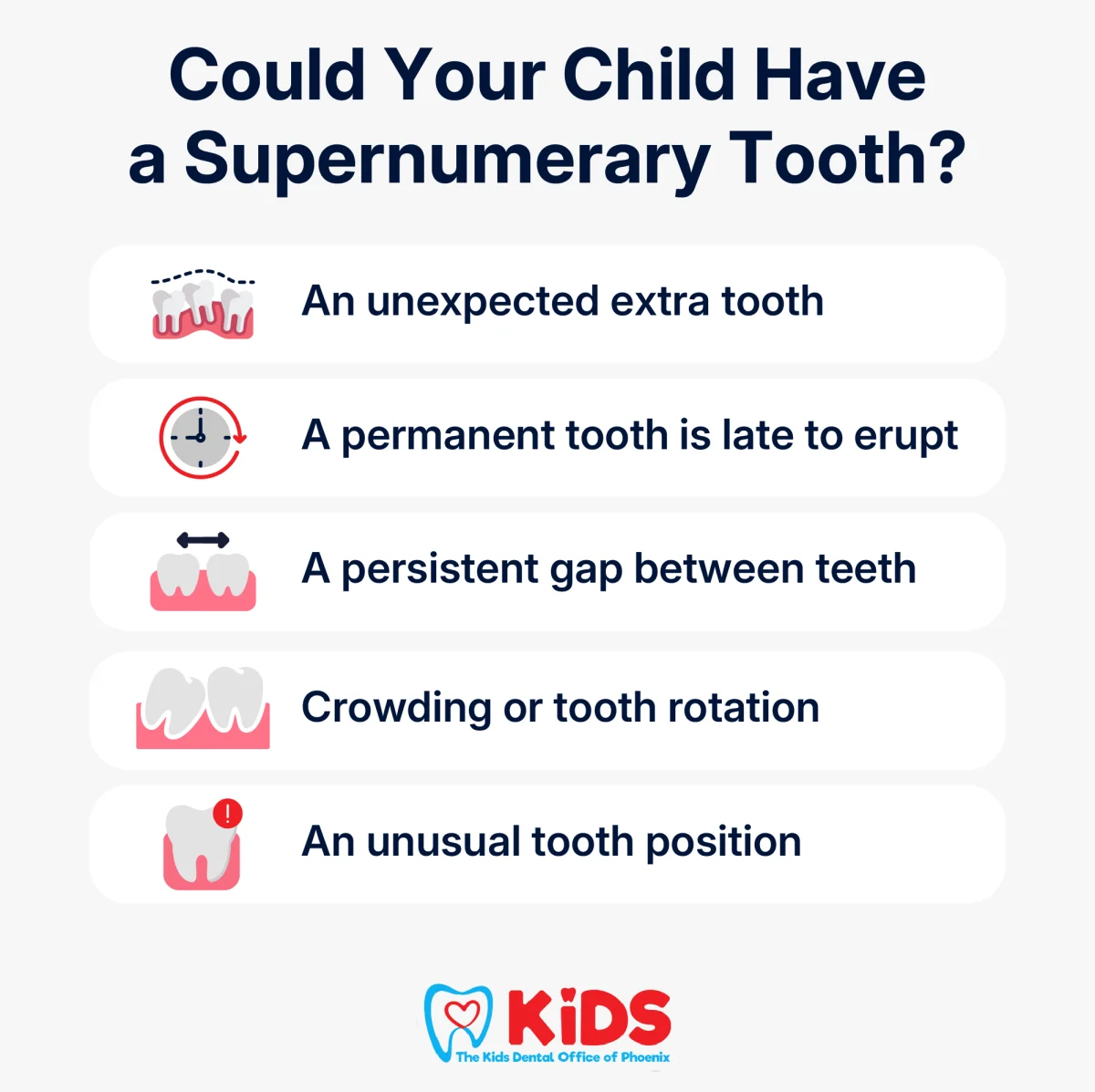
It is common for supernumerary teeth not to cause pain in your child. But you can still spot the early signs through careful observation of your child’s primary or permanent teeth and gums. Here are some signs to watch for:
- An unexpected tooth behind, between, or beside your child’s other teeth
- One permanent front tooth erupting while its matching tooth does not
- A baby tooth that stays in place while neighboring permanent teeth erupt around it
- A persistent or widening gap between the upper front teeth
- Teeth crowding, tooth rotation, or the displacement of an erupting tooth
- A tooth that appears in an unusual position, including high in the gum or toward the palate
- Unexplained swelling, drainage, tenderness, or discomfort in an area where a tooth has not erupted
Schedule a Kids Dental Evaluation
If you have noticed an unexpected tooth in your child’s mouth, or if one of your child’s permanent teeth seems late, blocked, or out of position, then schedule an evaluation with Kids Dental.
Through a pediatric dental examination, we can detect what is developing beneath the gums and help your family understand whether monitoring, removal, orthodontic treatment, or multidisciplinary care is appropriate.
Kids Dental provides pediatric oral health services to families through Phoenix metro locations in Avondale, Phoenix, Peoria, Scottsdale, and Surprise.
Request an appointment today so we can evaluate your child’s growing smile at the right time and with a plan designed for his or her individual needs.